
The Cost of Fast Judgement
We often celebrate leaders who make fast decisions. Experience, confidence and decisiveness are all qualities we associate with strong leadership. But what if the real differentiator isn't how quickly we decide, but how well we've tested the assumptions behind those decisions? In this month's thought paper, I explore why experienced leaders can sometimes become vulnerable to premature judgement, how untested assumptions quietly accumulate into what I call Assumption Debt, and why the most effective leaders aren't afraid to pause long enough to ask better questions before taking action.
Why the best leaders are curious before they're certain.
One of the fastest ways to lose trust isn't by making the wrong decision. Sometimes it's by becoming certain before you've earned the right to be.
Recently, I heard about a senior leader from a large multinational organisation visiting one of their businesses overseas. The purpose of the trip was straightforward: to meet a key customer and strengthen an important commercial relationship. It wasn't an operational review, nor a leadership assessment. Yet, as the visit unfolded, the leader found themselves drawn into commenting on how the local business was being run.
Observations became suggestions, company vehicles were queried, local practices challenged and operational decisions scrutinised, despite there being little understanding of the context in which those decisions had been made. The conversation drifted away from the purpose of the visit and towards solving problems that hadn't been fully understood.
Despite being surrounded by talented people who were part of their wider team and reporting lines, there was little curiosity about them. No real effort to understand the challenges they faced, the decisions they wrestled with each day, or the experience they had built within their own market. Instead, the leader stayed in familiar territory: numbers, detail and things that felt comfortably measurable.
It made me wonder how often experienced leaders, often with the very best intentions, default to the safety of what they already know rather than becoming curious about what they don't.
Perhaps that's because numbers feel objective. Processes feel solvable. Relationships, culture and local knowledge are far more nuanced. They take time, conversation and genuine curiosity to understand. Yet those are often the very things that determine whether a leader's decisions succeed or quietly unravel.
The irony is that this leader almost certainly had valuable insights to offer. Their experience was not the problem. The problem was assuming that experience alone provided enough context to judge what they were seeing.
And I suspect we've all done it.

Experience is invaluable, until it convinces us we've already understood
The irony of leadership is that the very thing that helps us succeed can also become the thing that quietly trips us up.
Experience gives us confidence. It enables us to recognise patterns, draw on previous successes (and past failures) and make decisions more quickly. Organisations value this. It's one of the reasons people are promoted into leadership roles in the first place. We expect experienced leaders to make sense of complex situations and to bring perspective that others may not yet have.
The challenge comes when confidence quietly becomes certainty.
Not the certainty our brains naturally seek to reduce uncertainty, that's a different conversation altogether (see my article Open Loops and Empty Tanks), but the certainty that says, "I already understand what's happening here." It can be incredibly subtle. We stop exploring and start interpreting. We observe something unfamiliar and immediately connect it to something familiar from our own experience.
Sometimes we're right.
Sometimes we're only seeing the surface.
I've often noticed that experienced leaders are remarkably good at spotting patterns. It's one of their greatest strengths. But pattern recognition without curiosity can become pattern assumption. We see what looks familiar and unknowingly fill in the gaps with our own history, our own context and our own specific experiences, forgetting that every organisation has its own story, every team has developed its own ways of working, and every decision has usually been made for a reason.
The assumptions themselves aren't the problem. We all make them. They're a natural part of how we interpret the world and make decisions every day. The risk comes when assumptions go untested. What feels like sound judgement can, in reality, be a decision built on incomplete understanding.
The strongest leaders I've worked with don't ignore their experience. They simply hold it lightly. Rather than allowing it to become immediate judgement, they treat it as a hypothesis to explore. They remain curious long enough to ask, "What might I be missing?" .

Every decision begins with an assumption
Whether we realise it or not, every leadership decision begins with something we believe to be true.
Sometimes those beliefs are based on years of experience, evidence and careful observation. Other times they're built on incomplete information, past successes or familiar patterns that may not apply in the situation we're facing today. The challenge isn't that assumptions exist (they always will), the challenge is recognising which assumptions have been tested, and which have simply been accepted because they feel right.
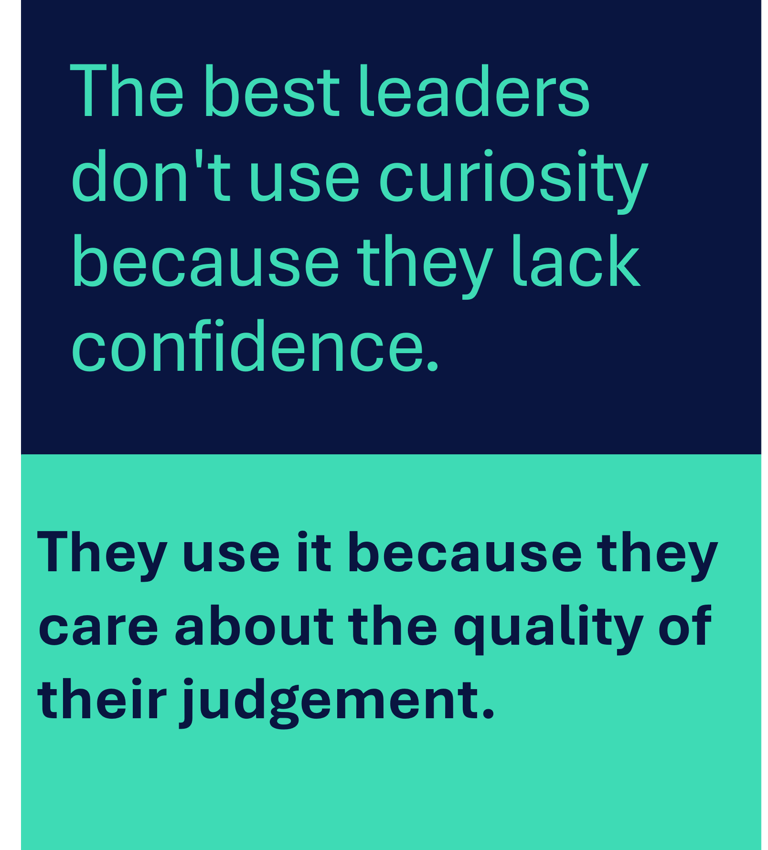
I've often reflected that curiosity is one of the most commercially valuable leadership disciplines we have, not because it makes us nicer leaders, but because it improves the quality of our judgement. Every assumption we test strengthens the decisions that follow. Every assumption we leave unchallenged increases the risk that we're solving the wrong problem, overlooking valuable expertise or unintentionally creating resistance where none previously existed.
This is why I don't see curiosity as hesitation or indecision. Quite the opposite. Curiosity is an investment in better judgement. It doesn't delay leadership; it strengthens it.
I've seen organisations spend months rebuilding trust after well-intentioned changes were introduced before enough questions had been asked. Equally, I've watched leaders invest an extra day listening to the people closest to the work, only to avoid costly mistakes and gain years of credibility because people felt understood rather than overridden.
The difference was the willingness to test assumptions before turning them into decisions.
Paying Down Your Assumption Debt
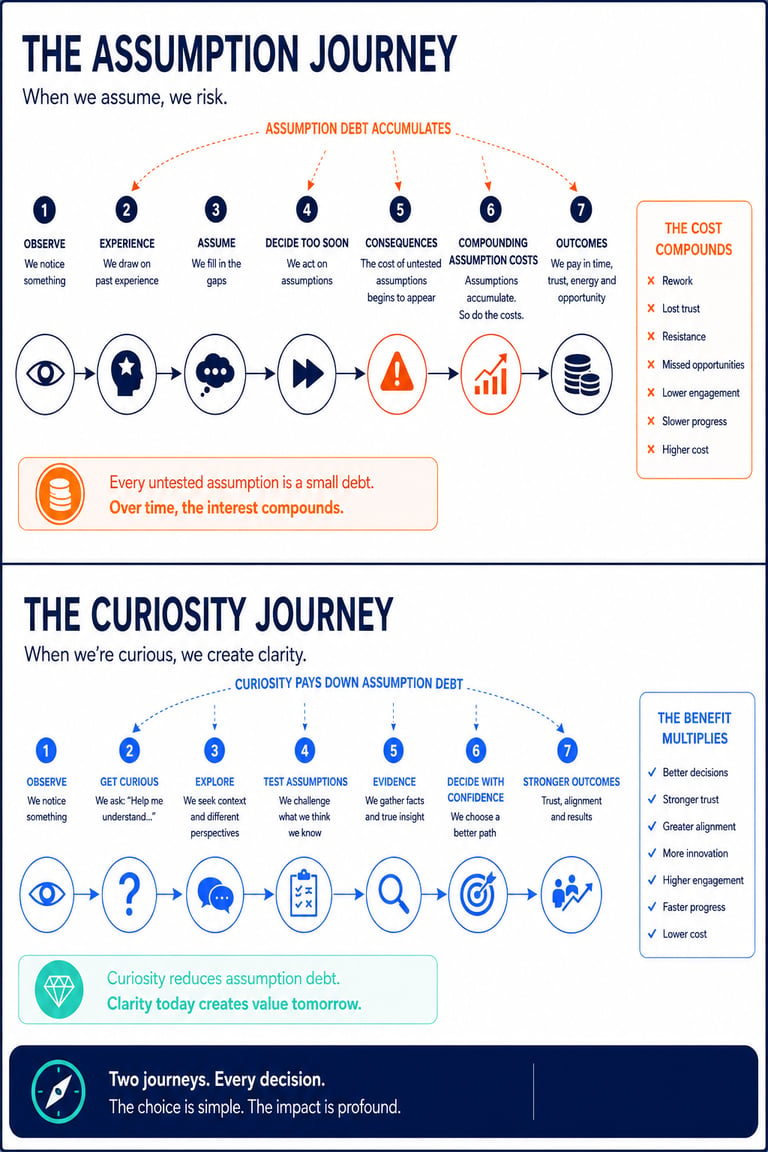
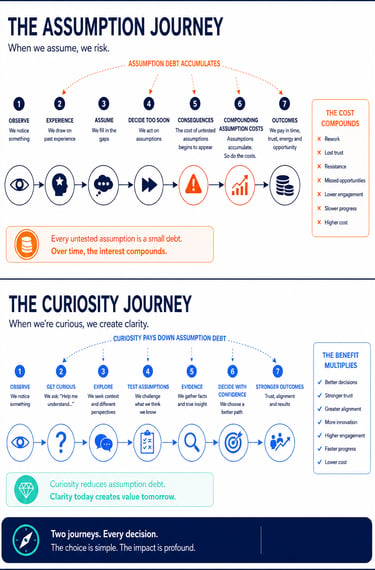
Looking at the two journeys, one thing becomes immediately apparent. Neither begins differently. Both start with exactly the same event: we observe something.
That's an important reminder because assumptions don't begin with poor leadership. They begin with normal leadership. We all notice things that don't make sense, appear inefficient or seem at odds with our previous experience. The difference isn't what we observe; it's what we do next.
The assumption journey is deceptively attractive because it feels efficient. We draw on our experience, fill in the gaps and move quickly towards judgement and action. In many situations that speed serves us well. But every time we skip over curiosity, we increase the risk of making decisions based on what we believe to be true rather than what we know to be true. That's where assumption debt begins to accumulate.
The curiosity journey takes a different route. It doesn't reject experience; it builds on it. Instead of treating experience as proof, it treats it as a starting point for exploration. Questions replace assumptions, context replaces interpretation and evidence strengthens judgement. The decision still comes, often just as quickly, but it rests on firmer foundations.
Over time, these two approaches create very different cultures. Leaders who repeatedly act on assumptions often wonder why they encounter resistance, why people seem reluctant to contribute or why the same problems continue to resurface. Conversely, leaders who consistently test their assumptions create environments where people feel heard, expertise is shared more freely and decisions are more likely to be understood and supported.
Perhaps the greatest lesson for me is that assumption debt rarely announces itself. Like many forms of debt, it accumulates quietly. The interest is paid later through rework, lost trust, slower progress or opportunities that never quite materialise. Curiosity, on the other hand, isn't simply a leadership behaviour; it's one of the most effective ways of reducing that debt before it compounds.
Closing Thought...
What This Means in Practice
The next time you notice something that doesn't look right, resist the temptation to move straight from observation to judgement. Pause just long enough to ask yourself whether you're looking at evidence or interpretation.
Before deciding what needs to change, spend time understanding why it exists today. Seek out the people closest to the work, especially those who aren't your direct reports or who may see the situation from a different perspective. Their experience is often the missing context that prevents assumption debt from accumulating.
Finally, remember that curiosity isn't about delaying decisions; it's about improving the quality of the judgement behind them. The most effective leaders I've worked with aren't slower to act. They're simply more disciplined about testing what they believe before acting upon it.
Reflection
Before your next important decision, ask yourself:
What assumptions am I making that I haven't yet tested?
Who in your organisation understands this better than I do? Go ask them.
Does this deserve one more conversation before you make it?