How to Grow Your SME Without Shaking What Makes it Strong
Growth can place pressure on the very foundations that made an SME successful in the first place. In this article, Tracy Filler explores the realities of scaling a business without losing the agility, trust, culture and human connection that helped it grow. From leadership evolution and delegation to communication, structure and capability, this is a practical look at how SMEs can grow sustainably without shaking what makes them strong.
A business grows and grows,
until eventually... it groans.
I’ve spent most of my leadership and consultancy career working with SMEs, so they are familiar territory to me. I’ve worked alongside incredible founders with seemingly endless energy, innovation and determination to grow their business and take people with them.
It has always felt personal, connected and close enough to genuinely influence outcomes. Decisions happen quickly. Relationships matter deeply. Leaders are visible. You can often feel the momentum of the business almost in real time.
I’ve deliberately avoided corporate life for much of my career and have always positioned my experience around the SME space. Yet one of the interesting realities of growth is that as businesses scale, you can accidentally find yourself operating in the very environment you once tried to avoid.
Whether that happens at leadership level, or simply as your own career grows inside a scaling organisation, it’s important to acknowledge that one environment is not inherently better than the other. They are simply different.
What Great Leadership Looks Like
in Any Sized Business
Clarity of direction
Effective delegation
Trust
Accountability
Communication
Decision-making
Emotional regulation under pressure
Role clarity
Leadership visibility
Psychological safety
Aligned priorities
Consistency between words and behaviour
Corporate environments tend to rely more heavily on:
Structure
Fovernance
Defined accountability
Stakeholder management
And scalable systems
SMEs, particularly start-ups and founder-led businesses, often thrive on:
Speed
Instinct
Closeness
Flexibility
And entrepreneurial energy
Neither approach is wrong. Both create opportunities and challenges. The difficulty often comes when businesses grow faster than the leadership habits, structures and communication styles underneath them.
And despite the obvious operational differences between SMEs and corporates, many of the fundamentals of great leadership remain remarkably consistent.
Whether a business has 30 people or 30,000, people still need to know:
What matters.
What good looks like.
What they are responsible for.
Where the business is heading.
And whether leadership can be trusted to navigate uncertainty.
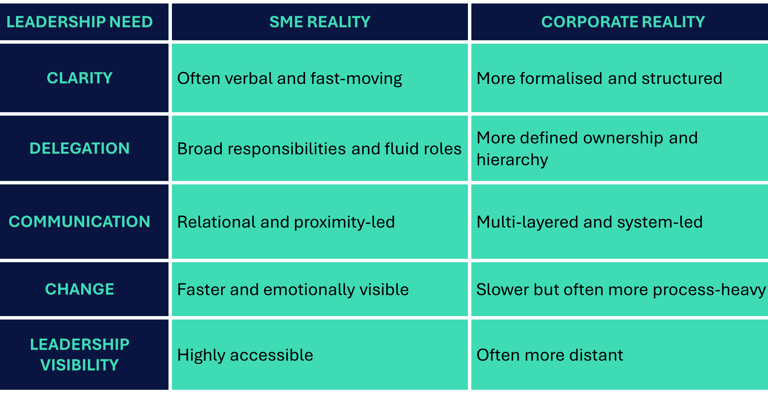
The strongest leaders learn how to adapt between both worlds
The differences between SMEs and corporates are often easy to spot at a high level. SMEs are typically faster, more relational and emotionally visible. Corporates are usually more structured, layered and process-driven.
But how those differences change the actual demands placed on leaders is far more nuanced.
In SMEs, leaders often sit much closer to both the opportunities and the pressure. Communication is faster, but sometimes less clear. Delegation can become blurred because people wear multiple hats. Visibility is high, which can create both stronger connection and greater emotional intensity during periods of change.
In corporates, leadership often becomes more distributed across systems, governance and layers of responsibility. Decision-making may slow, but clarity of ownership is often stronger. Communication travels further and through more channels, meaning leaders must work harder to maintain alignment and trust at scale.
The strongest leaders learn how to adapt between both worlds. They understand when a business needs agility and when it needs structure. They know how to introduce clearer processes without suffocating innovation, and how to scale leadership capability without losing the human connection that made the business successful in the first place.
The shift from relationship-led to structure-led growth
In early-stage SMEs, growth is often relationship-led. Leadership leverage comes through trust, proximity, inclusion and infectious enthusiasm for the cause. It is highly human-to-human and emotionally connected.
As businesses scale, growth naturally becomes more structure-led.
Decision-making broadens. Reporting lines evolve. Roles and responsibilities become more defined. Specialist expertise emerges. And sometimes, what once felt like your own little empire becomes part of a much bigger operational system.
Leadership can start feeling less relational and more operational.
That is not hierarchy for hierarchy’s sake. It is the business strengthening its structures, systems and operational foundations so they are robust enough to support ongoing growth.
You would never build a high-rise building on foundations designed for a garage, so why do we assume businesses can continue stacking higher and higher without strengthening what sits underneath them first?
This is the stage where leadership must begin working on the business, not just in the business.
It requires leaders to step back and honestly ask:
What is still working well?
What no longer serves us?
What needs tightening?
What needs upgrading?
And what risks are emerging as complexity increases?
Because sustainable growth is not simply about adding more. It is about building stronger foundations capable of carrying what comes next.
Leaders experience emotional shifts during this phase too
One of the least talked-about aspects of scaling a business is the emotional shift it creates for leaders themselves.
As SMEs professionalise, leadership often becomes emotionally less accessible. Not necessarily because leaders care less, but because the organisational model itself is changing.
Founders and senior leaders who were once deeply involved in everything can suddenly find themselves:
Less operationally involved
More commercially stretched
Communicating more carefully
And further away from the day-to-day relationships that once defined the culture
There can be a sense of
emotional loss of the
"old SME feeling"
For employees and emerging leaders, that shift can feel deeply personal. What once felt close and highly relational can start feeling:
More structured
Less instinctive
And occasionally more distant
But often this is not a sign of disengagement. It is a natural consequence of growth creating broader operational demands, more layers of accountability and increasing organisational complexity.
The challenge for leadership is recognising that while the structure of the business may need to evolve, people still need visibility, communication and trust during periods of change.
Growth changes what leadership requires
Early-stage SMEs often reward:
Hustle,
Responsiveness,
Flexibility,
Relationship-building,
And the ability to solve problems quickly.
People grow through visibility, energy and proximity to decision-making.
The capabilities that help build a business are not always the same ones required to scale it sustainably.
As businesses scale, different
leadership capabilities
begin to matter more.
Growth starts demanding:
Systems thinking,
Prioritisation,
Clearer delegation,
Operational ownership,
Strategic judgement,
Cross-functional communication,
And the ability to lead through ambiguity.
This is often the point where capability gaps become more visible.
Not because people are failing, but because the demands of leadership itself are changing. The business is becoming more complex, and complexity changes how leadership shows up.
The leaders who thrive during this phase are usually the ones who can adapt their style alongside the business. They learn how to move from doing everything themselves to building systems, developing people and creating clarity at scale.
Because sustainable growth does not just require bigger businesses.
It requires more mature leadership alongside it.
Closing Thought...
Sustainable growth changes everyone!
One of the biggest myths in business is that growth simply means “more.”
More people.
More revenue.
More customers.
More opportunity.
Sustainable growth asks much deeper questions.
Can people still feel connected to the purpose, pace and direction that made the business exciting in the first place?
Because the strongest SMEs are rarely the ones that avoid change.
They are the ones willing to strengthen the foundations while they grow. The ones prepared to let go of ways of working that no longer serve them. The ones willing to develop leaders before problems escalate. And the ones wise enough to recognise that growth changes both businesses and the people inside them.
Growth will always place pressure on a business.
The question is whether that pressure exposes cracks… or creates stronger foundations for what comes next.
Reflection
Leadership Lens
Is the leadership evolving alongside the business?
Is communication staying clear as complexity and scale increases?
Are structures strengthening the business, or slowing it down?
Are leaders spending enough time working on the business, not just in it?
What foundations will the next phase of growth demand?