
Curiosity Before Control
Leaders are quick to respond to behaviour they don’t like. But what if they’re misreading what’s really going on? Following on from how uncertainty impacts the brain, this article explores what happens next; why moving too quickly to correct can make things worse, and how curiosity before control leads to better outcomes for both people and performance.
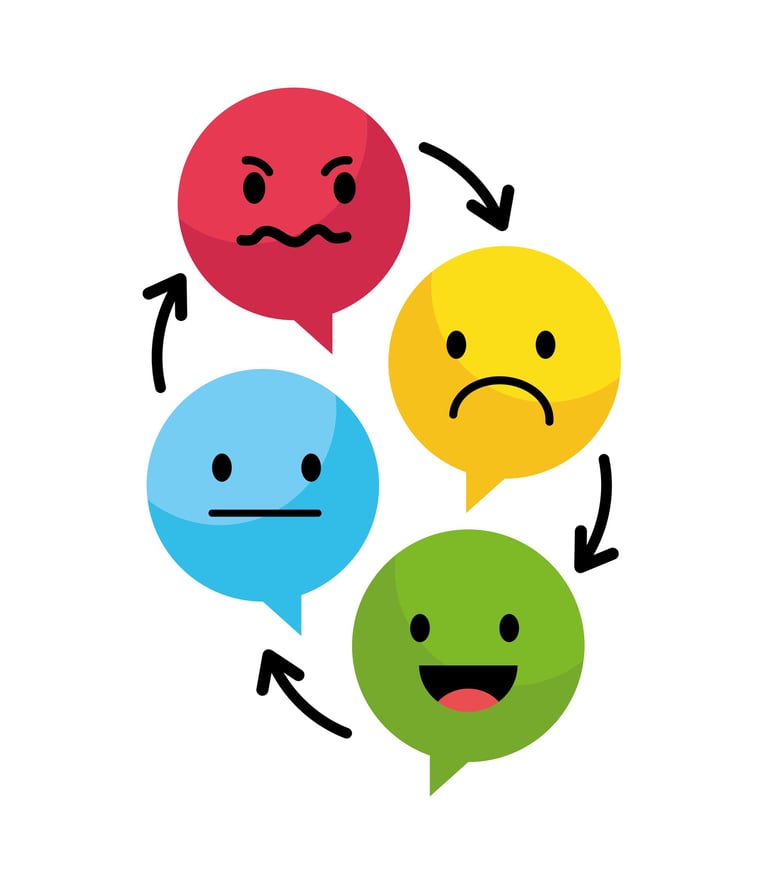
Behaviour is a signal. Most leaders treat it as a problem.
Not All Behaviour Is What It Looks Like
Last month, I wrote about how uncertainty drains the brain.
How open loops, unclear decisions and shifting direction force people into prediction mode, scanning for threat instead of focusing on performance.
When the brain is working this hard to answer “what happens next?”, energy shifts away from thinking, problem-solving and creativity.
This month, I want to take that one step further. Because what leaders often do next is where the real cost shows up.
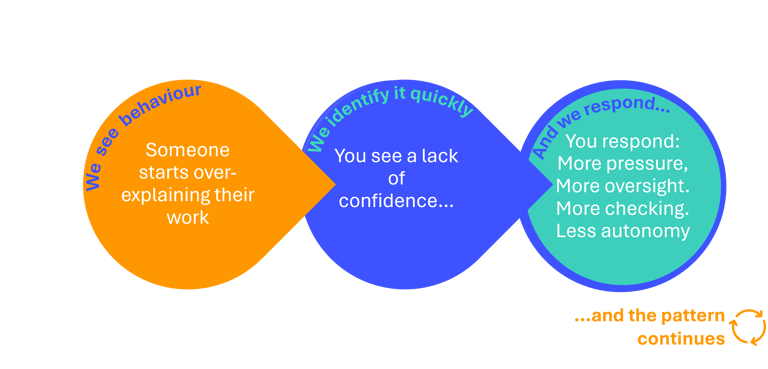
We see behaviour.
We identify it quickly.
And we respond, without questioning what’s driving it.
On the surface, it looks like performance management.
But often… it isn’t.
The Pattern
You'll recognise it!
A team member becomes quiet in meetings.
Another starts over-explaining their decisions.
Someone else reacts sharply to what feels like a small piece of feedback.
It gets identified quickly:
Defensive
Disengaged
Over-sensitive
Not coping
And the response follows just as fast:
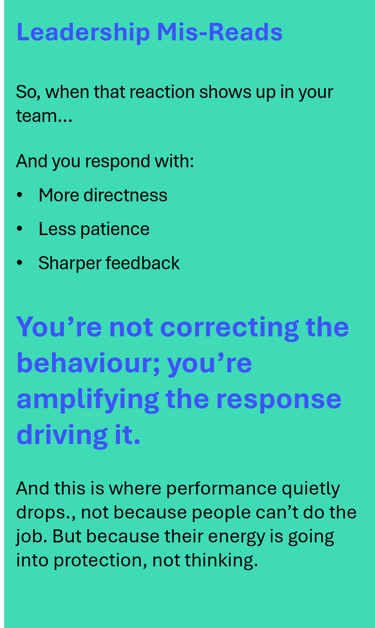
More direction
More pressure
More correction
Reflection
A Different Lens
Instead of asking
“What's wrong here?”
“How do I fix this behaviour?”
“What do I need to correct?”
Start asking:
“What might be driving this?”
“Am I responding to the signal… or my interpretation of it?”
“What do I need to understand?”
The Shift
If the brain is already under pressure, trying to close loops, reduce uncertainty and predict what happens next, then behaviour starts to change.
Not because capability has dropped, because the system is protecting itself.
And this is where leaders get caught out.
They respond to what they see.
Not what’s driving it.
The Dual Impact
Not all brains process feedback, pressure, or uncertainty in the same way.
Some people experience feedback as just that, information to act on.
Others experience it as something much stronger.
A threat.
A signal.
In that moment it sticks, feels deeper and lasts longer than intended.
So What's Going On?
There’s a term for this Rejection Sensitive Dysphoria (RSD).
But you don’t need the label to recognise the pattern.
You’ll have seen it (and possibly felt it):
A disproportionate reaction to a small comment
Withdrawal after feedback
Overcompensation or perfectionism
Or silence where there used to be contribution
For some people, this isn’t about resilience, It’s about wiring and often experience.
It’s estimated that some individuals, particularly those with ADHD receive an average of 20,000 more criticisms growing up than others. So the brain learns quickly and sees any criticism as a threat, and any feedback as risk. This is an unconscious move by the brain as part of its primary function to protect.
This Is How To Subtly Re-Write The Playbook
This is where leadership needs to change - it's not about being softer, and like many pivotal changes, it's quite simple, and yet not so easy to implement: Curiosity before control.
Instead of asking:
“What’s wrong here?”
Start asking:
“What might be driving this?”
Watch what happens when you:
Separate behaviour from intent
Pay attention to how feedback is sitting, not just how it’s delivered
Slow the moment down instead of reacting to it
Find clarity before adding pressure
(this is where curiosity comes in - ask questions!)
Because not every reaction needs correcting.
Some need understanding.
Closing Thought...
Last month, we talked about how uncertainty drains the brain.
This is what that looks like in real life.
Not just slower thinking.
But changed behaviour.
And if we misread that behaviour…
We don’t just miss the problem.
We become part of it.